Guns carried in public pose a danger to public safety, and lax concealed carry laws increase the risk of violent confrontations.
The carrying of concealed, loaded guns in public places can quickly escalate everyday conflicts into deadly altercations, causing tragic, irreversible damage to innocent lives. These dangers are amplified when states weaken their standards for who is qualified to carry loaded weapons in public, or when states eliminate these standards and protections entirely.
Background
Source
John J. Donohue, Abhay Aneja, and Kyle D. Weber, “Right‐to‐Carry Laws and Violent Crime: A Comprehensive Assessment Using Panel Data and a State‐Level Synthetic Control Analysis,” Journal of Empirical Legal Studies 16, no. 2 (2019): 198–247.
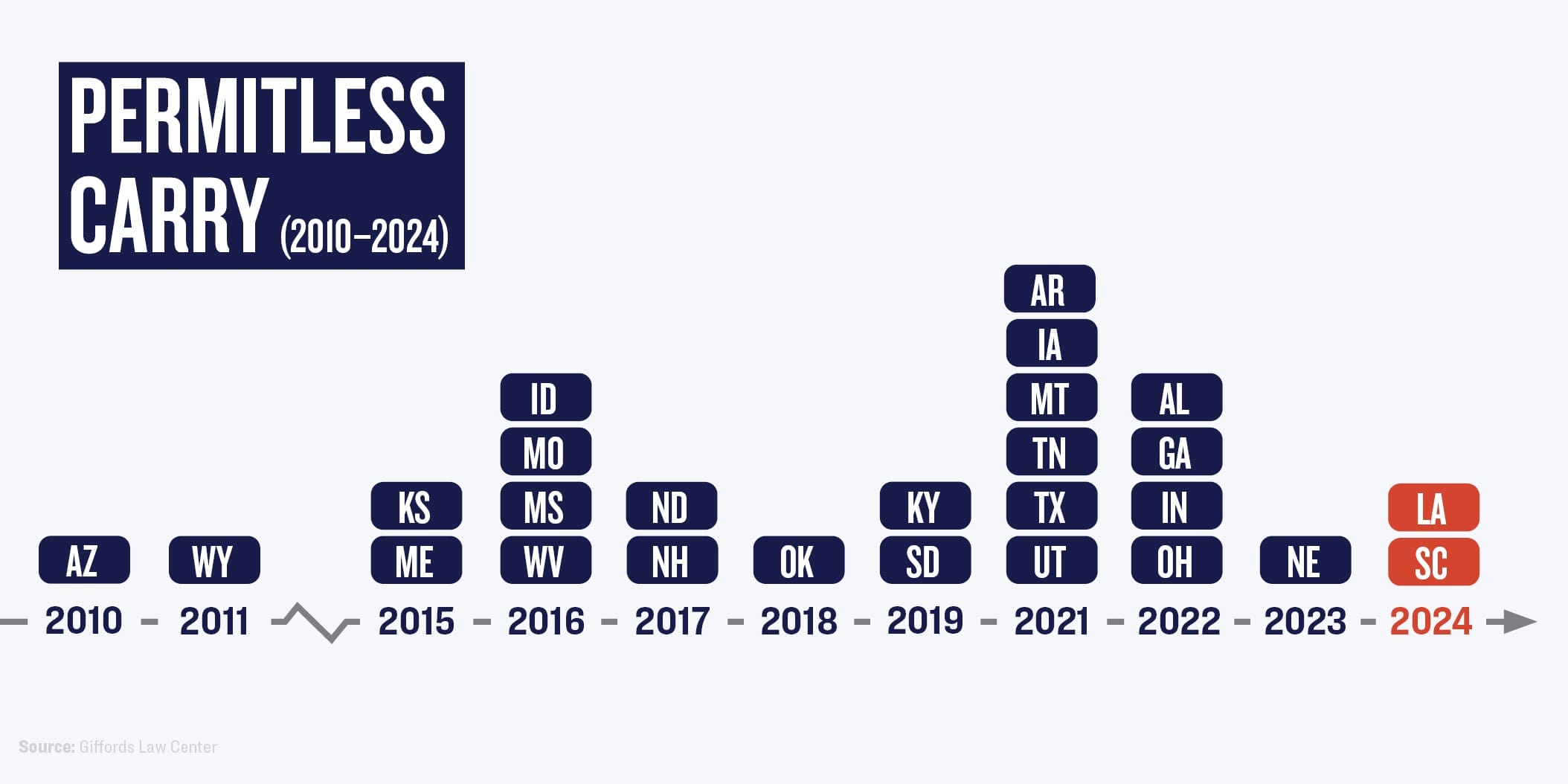
Historically, almost every state prohibited or strictly limited the carrying of concealed, loaded weapons in public places. These restrictions were among the earliest gun laws adopted in the United States. In the late 20th century, some states began to grant law enforcement discretion to issue permits (often called “CCW” or carrying a concealed weapon permits) to people who passed a background check and received firearm safety training and/or demonstrated a particular need to carry hidden, loaded guns in public. At the behest of the gun lobby, however, many states have in recent years substantially weakened standards for qualifying for these permits—and 26 states have now eliminated these protections entirely.
These changes have enormously expanded the number of people who are authorized to carry hidden, loaded handguns in public streets, crowds, and spaces, and also often significantly increased the number of public locations in which the public may carry firearms, including public parks and schools, college campuses, hospitals, government buildings, bars, and many others.
- Researchers estimated in 2015 that 9 million US adults carry loaded handguns monthly,1 and that 3 million carry loaded handguns every day.2
- Proportionally fewer people carry concealed loaded handguns in states that have strong concealed carry permitting standards.3
Many people may be surprised to learn just how lax many states’ standards are. In 2020, a member of the US Commission on Civil rights expressed alarm that weak public carry laws like the state of Florida’s still allowed the man who murdered Trayvon Martin to possess and carry loaded concealed firearms in public, despite his history of domestic violence and assaulting a police officer, killing Trayvon Martin, and then subsequently being convicted of criminally stalking someone else.4 Of the 26 states that now authorize people to carry concealed handguns in public without a permit or background check required, all but one also allow people to purchase handguns without a background check too, meaning that the residents of 25 states are generally able to purchase and carry concealed weapons designed to take human life in most public spaces without ever passing any background check whatsoever, or ever receiving any safety training or information about safe and responsible handling of firearms.
Guns carried in public pose a substantial threat to public safety. A robust body of academic literature shows that when more people carry guns in public, violent crime increases.
- The most comprehensive and rigorous study of concealed carry laws found that in states with weak permitting laws, violent crime rates were 13% to 15% higher than predicted had such laws not been in place.5
- Weak concealed-carry permitting laws are also associated with 11% higher rates of homicide committed with handguns compared with states with stronger permitting systems.6
- The dangerous impacts of weak permitting laws also extend to nonfatal injuries. States that weakened their permitting laws saw a 9.5% increase in rates of gun assaults in the first 10 years after adopting these weaker standards.7
Studies found that certain aspects of the permitting process have been beneficial, including live-fire training and prohibitions preventing people with a history of misdemeanor violence from carrying in public. In fact, states that ended live-fire training requirements when adopting permitless carry laws saw a 32% increase in gun assaults.8
There is also some evidence that lax concealed carry laws increase other undesirable outcomes, including police shootings of civilians, gun thefts, and unintentional gun injuries.
- A study of states that adopted permitless concealed carry laws found that such states experienced a 13% increase in fatal and nonfatal police shootings of civilians compared to what would have been expected had stronger carrying standards remained in place.9
- People who carried firearms at least once in the past month were three times more likely to have had a firearm stolen than other gun owners.10
- Similarly, one analysis suggests that unintentional firearm injuries may occur more frequently after states weaken permitting standards.11
In addition to the robust evidence showing the dangers of permissive public carry laws, there is no research that suggests expanding public carry has any public safety benefits.
- Firearms are rarely used successfully in self-defense. In fact, individuals successfully defend themselves with a gun in less than one percent of crimes.12
- In the rare instances in which firearms are used in self defense, research shows that using a firearm did not reduce a person’s chance of being injured during criminal victimization more than other various forms of protection did.(())
- Carrying a firearm may actually increase a victim’s risk of firearm injury during the commission of a crime.13
Summary of Federal Law
Federally Mandated CCW
In recent years, the gun lobby has been pushing federal legislation that would mandate that each state recognize concealed carry permits from every other state. So far, such efforts have been unsuccessful. Many states have extremely lax permitting laws; many states do not even require a permit to carry concealed. Forcing states with strong CCW laws like California and New York to comply with weak laws from states like Florida and Louisiana will endanger public safety and make it significantly harder for police to enforce gun laws proven to save lives.
SUPPORT GUN SAFETY
We’re in this together. To build a safer America—one where children and parents in every neighborhood can learn, play, work, and worship without fear of gun violence—we need you standing beside us in this fight.
Law Enforcement CCW
Federal law provides that certain law enforcement officers may carry concealed firearms. Any “qualified law enforcement officer” with proper agency-issued identification may carry a concealed firearm.14 “Qualified retired law enforcement officer” with proper identification may also carry a concealed firearm.15 Both statutes supersede state and local laws regarding concealed carry by law enforcement except in certain circumstances. States are not precluded from allowing private persons or entities to prohibit or restrict the possession of concealed firearms on their property by current or retired law enforcement. States also are not precluded from prohibiting or restricting the possession of firearms by current or retired law enforcement on any state or local government property, installations, buildings, bases, or parks.
Background Check Exception
Significantly, a person holding a state-issued permit allowing the person to acquire or possess firearms (e.g., a concealed weapons permit) is not required to undergo a background check if the permit was issued: (1) within the previous five years in the state in which the transfer is to take place; and (2) after an authorized government official has conducted a background investigation to verify that possession of a firearm would not be unlawful.16 Permits issued after November 30, 1998 qualify as exempt only if the approval process included a NICS check.17
This exemption threatens public safety because it allows a prohibited person to acquire a firearm when the person falls into a prohibited category after issuance of the state permit and the state has not immediately revoked the permit. Under the federal exemption, no background check is required and the seller would have no way to learn that the prospective purchaser is prohibited from possessing firearms. For more information about this exemption, see our summary on Background Check Procedures.
Summary of State Law
Every state—as well as the District of Columbia—authorizes people to carry concealed weapons in public in some form. Twenty-one states generally require a state-issued permit in order to carry concealed weapons in public (CCW permit).18 However, the remaining 29 (Alabama, Alaska, Arizona, Arkansas, Florida, Georgia, Idaho, Indiana, Iowa, Kansas, Kentucky, Louisiana, Maine, Mississippi, Missouri, Montana, Nebraska, New Hampshire, North Dakota, Ohio, Oklahoma, South Carolina, South Dakota, Tennessee, Texas, Utah, Vermont, West Virginia, and Wyoming) now generally allow people to carry concealed weapons in most public spaces without any permit, background check, or safety training at all. (However, 28 of these 29 states still issue CCW permits; individuals may desire them to qualify for an exemption from federal law’s background check requirements when purchasing a firearm, or so that they may carry concealed weapons in other states or additional locations.)
Of the 29 states that do not require a permit or background check to carry a loaded, concealed weapon in public, only two of them—Nebraska and Vermont—require a background check to purchase some or all firearms. In other words, in 27 states, a person may purchase and carry a firearm in public without any background check. See Universal Background Checks for more information.
States That Require CCW Permit
- California19
- Colorado20
- Connecticut21
- Delaware22
- District of Columbia23
- Hawaii24
- Illinois25
- Maryland26
- Massachusetts27
- Michigan28
- Minnesota29
- Nevada30
- New Jersey31
- New York32
States That Do Not Require CCW Permit
- Alabama (Effective Jan. 1, 2023)41
- Alaska42
- Arizona43
- Arkansas (effective approximately August 29, 2021)44
- Idaho45
- Iowa (effective July 1, 2021)46
- Indiana (effective July, 1, 2022)47
- Florida (effective July 1, 2023)48
- Georgia49
- Kansas50
- Kentucky51
- Louisiana (effective July 4, 2024)52
- Maine53
- Mississippi54
- Missouri55
- Montana 56
- Nebraska (effective September 10, 2023)57
- New Hampshire58
- North Dakota59
- Ohio60
- Oklahoma61
- South Carolina62
- South Dakota63
- Tennessee64
- Texas (effective Sept. 1, 2021)65
- Utah66
- Vermont67
- West Virginia68
- Wyoming69
suitable person requirements
Source
Michael Siegel, et al., “Easiness of Legal Access to Concealed Firearm Permits and Homicide Rates in the United States,” American Journal of Public Health 107, no. 12 (2017): 1923–1929.
Ten states and the District of Columbia require applicants to establish that they are “suitable persons” to carry a concealed weapon before being issued a permit. Some states call this a “good moral character” requirement. For example, Connecticut will not issue permits to “individuals whose conduct has shown them to be lacking the essential character of temperament necessary to be entrusted with a weapon.”70 New Jersey requires that three “reputable persons” who have known the applicant for at least three years certify that the applicant is of “good moral character and behavior.” Delaware also requires that the applicant include with his or her application a certificate signed by five “respectable citizens” of the county in which the applicant resides stating that the applicant is of good moral character, has a reputation for peace and good order, and that possession of a concealed deadly weapon by the applicant is necessary for the protection of the applicant or the applicant’s property. Indiana requires that the applicant be of good character and reputation. Rhode Island requires a person to either have a suitable character or make a “proper showing of need.”
Some states that do not have an affirmative “suitable person” application requirement still allow a CCW application to be denied to a person who is not categorically ineligible if law enforcement can show a documented reason to believe the person is dangerous.
States That Require an Applicant to be a Suitable Person
- California
- Connecticut
- Delaware
- District of Columbia
- Georgia (permit not required for concealed carry)
- Hawaii
- Indiana (permit not required for concealed carry)
- Maine (permit not required for concealed carry)
- Massachusetts
- New Jersey
- New York
- Rhode Island (as an alternative to a proper showing of need)
States Without a Suitable Person Requirement that Allow Denials When There is Reason to Believe the Person is Dangerous
- Alabama (permit not required for concealed carry)
- Arkansas (permit not required for concealed carry)
- Colorado
- Illinois
- Iowa (permit not required for concealed carry)
- Maryland
- Minnesota
- Missouri (permit not required for concealed carry)
- Montana (permit not required for concealed carry)
- North Dakota (permit not required for concealed carry)
- Oregon
- Pennsylvania
- South Carolina (permit not required for concealed carry)
- South Dakota (permit not required for concealed carry)
- Utah (permit not required for concealed carry)
- Virginia
- Wyoming (permit not required for concealed carry)
GET THE FACTS
Gun violence is a complex problem, and while there’s no one-size-fits-all solution, we must act. Our reports bring you the latest cutting-edge research and analysis about strategies to end our country’s gun violence crisis at every level.
Learn More
States Requiring Applicants to Demonstrate Knowledge of Firearm Use and/or Safety
More than half of the states and the District of Columbia require a CCW permit applicant to demonstrate that they have received training in firearm use and/or safety. 71
For example, California, Connecticut, Delaware, Hawaii, Maryland, Massachusetts, New Jersey, New York, and the District of Columbia require applicants to complete a firearm safety course, or otherwise demonstrate their qualification to use a firearm safely.
Delaware’s firearm safety training requirement, which applies to the applicant’s initial CCW license only, is particularly strong, and specifies that the training course must include instruction regarding:
- Knowledge and safe handling of firearms and ammunition;
- Safe storage of firearms and ammunition and child safety;
- Safe firearms shooting fundamentals;
- Federal and state laws pertaining to the lawful purchase, ownership, transportation, use, and possession of firearms;
- State laws pertaining to the use of deadly force for self-defense; and
- Techniques for avoiding a criminal attack and how to manage a violent confrontation, including conflict resolution.
Delaware also requires that the training include live fire-shooting exercises on a range, including the expenditure of a minimum of 100 rounds of ammunition, and identification of ways to develop and maintain firearm-shooting skills. Finally, Rhode Island requires applicants to obtain a certification that they are qualified to use a handgun of a caliber equal to or larger than the one they seek to carry. The certification can be obtained by passing a firing test conducted by a range officer or pistol instructor. Such thorough training requirements help ensure that only highly trained individuals are allowed to carry concealed firearms in public areas.
States Limiting the Locations where Concealed Weapons May be Carried
Almost every state imposes at least some restrictions on the locations in which concealed weapons may be carried. For more information, see our page on Location Restrictions.
Other Restrictions on Permits
State concealed weapons permits vary in duration and renewal processes. The strongest laws limit the duration of permits and require applicants for renewal of a permit to undergo a complete background check and complete safety training and testing. Strong state laws also require the immediate revocation of a permit if the permit-holder becomes ineligible for the permit or violates a law regarding firearms.
State laws also vary regarding the carrying of concealed weapons by individuals who have obtained a permit from a different state. The strongest state laws limit the carrying of concealed weapons to individuals who have obtained a permit from that state. Other states limit carrying to individuals with permits from states that have similar requirements for their permits. The states with the weakest laws allow carrying by individuals with permits from any state that recognizes that state’s permit, or by individuals with permits from any state.
Key Legislative Elements
The features listed below are intended to provide a framework from which policy options may be considered. A jurisdiction considering new legislation should consult with counsel.
- A license or permit to carry is required.
- Law enforcement should issue permits based on objective guidelines and only to those individuals who can show they are suitable persons to carry concealed weapons.
- In addition to background checks, applicants are required to have safety training and to pass written and hands-on tests demonstrating knowledge of firearm laws and safety (27 states require some form of firearm training/knowledge).
- Applicants must be 21 years of age or over.
- Restrictions are placed on the locations where carrying concealed weapons is permitted, prohibiting the carrying of concealed weapons in sensitive areas such as schools, courthouses, legislative buildings, polling stations, hospitals, mental health institutions, bars, and public sporting events.
- Permits are of limited duration and may be renewed only upon satisfaction of all conditions and testing, including background checks.
- Permits are subject to revocation in cases where holder becomes prohibited from possessing firearms or fails to comply with applicable federal, state, and local firearms laws.
RELATED
Open Carry
Universal Background Checks
Location Restrictions
- Ali Rowhani-Rahbar, et al., “Loaded Handgun Carrying Among US Adults, 2015,” American Journal of Public Health 107, no. 12 (2017): 1930–1936.[↩]
- Id.[↩]
- Id.[↩]
- See US Commission on Civil Rights, “Examining the Race Effects of Stand Your Ground Laws and Related Issues,” Statement of Commissioner Michael Yaki, February 2020, 20 (citing “George Zimmerman’s Stalking Victim Demands His Concealed Weapon License be Revoked,” The Blast, November 30, 2018, https://theblast.com/george-zimmerman-stalking-victim-demands-his-concealed-weapon-license-be-revoked/.) [↩]
- John J. Donohue, Abhay Aneja, and Kyle D. Weber, “Right to Carry Laws and Violent Crime: A Comprehensive Assessment Using Panel Data and a State Level Synthetic Control Analysis,” Journal of Empirical Legal Studies 16, no. 2 (2019): 198–247.[↩]
- Michael Siegel, et al., “Easiness of Legal Access to Concealed Firearm Permits and Homicide Rates in the United States,” American Journal of Public Health 107, no. 12 (2017): 1923–1929.[↩]
- Mitchell L. Doucette, et al., “Impact of Changes to Concealed-Carry Weapons Laws on Fatal and Nonfatal Violent Crime, 1980-2019,” American Journal of Epidemiology 192, no. 3 (2022): 342-355.[↩]
- Mitchell L. Doucette, et al., “Deregulation of public civilian gun carrying and violent crimes: A longitudinal analysis 1981-2019,” Criminology & Public Policy 00 (2023): 1-29; See also, Mitchell L. Doucette, et al., “Impact of Changes to Concealed-Carry Weapons Laws on Fatal and Nonfatal Violent Crime, 1980-2019,” American Journal of Epidemiology 192, no. 3 (2022): 342-355.[↩]
- Mitchell L. Doucette et al., “Officer-Involved Shootings and Concealed Carry Weapons Permitting Laws: Analysis of Gun Violence Archive Data, 2014—2020,” Journal of Urban Health (2022). [↩]
- David Hemenway, Deborah Azrael, and Matthew Miller, “Whose Guns are Stolen? The Epidemiology of Gun Theft Victims,” Injury Epidemiology 4, no. 1 (2017).[↩]
- Jeffrey DeSimone, Sara Markowitz, and Jing Xu, “Child Access Prevention Laws and Nonfatal Gun Injuries,” Southern Economic Journal 80, no. 1 (2013): 5–25. See also, “Effects of Concealed-Carry Laws on Unintentional Injuries and Deaths,” RAND, Gun Policy in America, https://www.rand.org/research/gun-policy/analysis/concealed-carry/unintentional-injuries.html.[↩]
- David Hemenway and Sara J. Solnick, “The Epidemiology of Self-defense Gun Use: Evidence from the National Crime Victimization Surveys 2007–2011,” Preventive Medicine 79 (2015): 22–27.[↩]
- Charles C. Branas, et al., “Investigating the Link Between Gun Possession and Gun Assault,” American Journal of Public Health 99, no. 11 (2009): 2034–2040.[↩]
- 18 U.S.C. § 926B.[↩]
- 18 U.S.C. § 926C.[↩]
- 18 U.S.C. § 922(t)(3); 27 C.F.R. § 478.102(d).[↩]
- 27 C.F.R. § 478.102(d).[↩]
- Of these twenty-one states, six states had what were called “may issue” laws that allowed issuing authorities discretion to deny a permit unless the applicant showed a particular need. In NYSRPA v. Bruen, the Supreme Court held that New York’s “may issue” law violated the Second Amendment, as incorporated by the Fourteenth Amendment. Following Bruen, these jurisdictions issued guidances that licensing authorities should not enforce the may-issue provisions in these laws. Prior to Bruen, the D.C. Circuit had held that the District of Columbia’s “may issue” law violated the Second Amendment. See Wrenn v. District of Columbia, 864 F.3d 650, 655 (D.C. Cir. 2017).[↩]
- Cal. Penal Code §§ 25400-25700, 26150-26225.[↩]
- Colo. Rev. Stat. §§ 18-12-203, 18-12-215.[↩]
- Conn. Gen. Stat. §§ 29-28 – 29-30, 29-32, 29-32b, 29-35, 29-37.[↩]
- Del. Code Ann. tit. 11, §§ 1441, 1442.[↩]
- D.C. Code Ann. § 22-4506.[↩]
- Haw. Rev. Stat. Ann. § 134-9.[↩]
- 430 Ill. Comp. Stat. 66/1 – 66/110 (effective Jan. 2014).[↩]
- Md. Code Ann., Pub. Safety §§ 5-301 – 5-314.[↩]
- Mass. Gen. Laws ch. 140, §§ 131, 131C, 131P; ch. 269, § 10.[↩]
- Mich. Comp. Laws §§ 28.421a – 28.429c.[↩]
- Minn. Stat. § 624.714.[↩]
- Nev. Rev. Stat. Ann. §§ 202.3653 – 202.369.[↩]
- N.J. Stat. Ann. §§ 2C:58-3, 2C:58-4, 2C:39-5.[↩]
- N.Y. Penal Law §§ 265.01, 265.20, 400.00.[↩]
- N.M. Stat. Ann. §§ 29-19-1 – 29-19-13, 30-7-2.4, 30-7-3, 30-7-13.[↩]
- N.C. Gen. Stat. §§ 14-415.10 – 14-415.24, 14-269.2, 14-269.3, 14-277.2.[↩]
- Or. Rev. Stat. §§ 166.291 – 166.297, 166.370.[↩]
- 18 Pa. Cons. Stat. §§ 6106, 6109, 912, 913; 55 Pa. Code §§ 3270.79, 3280.79, 3800.101, 6400.86.[↩]
- R.I. Gen. Laws §§ 11-47-8 – 11-47-18.[↩]
- Va. Code Ann. §§ 18.2-308 – 18.2-308.015, 18.2-283, 18.2-283.1, 18.2-287.01.[↩]
- Wash. Rev. Code Ann. §§ 9.41.070 – 9.41.075, 9.41.097, 9.41.280, 9.41.300, 9.41.800.[↩]
- Wis. Stat. § 175.60.[↩]
- Ala. Code § 13A-11-85.[↩]
- Alaska Stat. § 11.61.220(a). CCW permitting: Alaska Stat. § 18.65.700 et seq.[↩]
- Ariz. Rev. Stat. § 13-3102. Enacted in 2010. CCW permitting: Ariz. Rev. Stat. § 13-3112.[↩]
- Ark. Code Ann. §§ 5-73-101 (defining “journey” to be any travel outside the home), 5-73-120(c)(4).[↩]
- Idaho Code § 18-3302 as amended by 2016 ID S 1389. Enacted in 2016. CCW Permitting: Idaho Code § 18-3302.[↩]
- 2021 IA HB 756, amending Iowa Code § 724.5. See also Iowa Code §§ 724.4, 724.4B, 724.7 – 724.13.[↩]
- Ind. Code Ann. § 14-16-1-23.[↩]
- Fla. Stat. § 790.01.[↩]
- Ga. Code Ann. §16-11-125.1.[↩]
- Kan. Stat. Ann. § 21-6302(4). Enacted in 2015. CCW permitting: Kan. Stat. Ann. § 75-7C,03.[↩]
- 2019 KY SB 150. Ky. Rev. Stat. Ann. §§ 237.109, 527.020.[↩]
- 2024 La. SB 1, amending La. Rev. Stat. Ann. §§ 14:95(M).[↩]
- See Me. Rev. Stat. tit. 25, § 2001-A et seq. Enacted in 2015.[↩]
- 2016 Miss. H.B. 786, signed by the governor April 15, 2016, amending Miss Code Ann. § 97-37-7(24).[↩]
- 2016 Mo. S.B. 656, Governor’s veto overridden Sept 14, 2016, amending Mo. Rev. Stat. §§ 571.030.[↩]
- 2021 MT HB 102, signed by the governor February 18, 2021, amending Mont. Code Ann. § 45-8-316.[↩]
- Neb. Rev. Stat. §§ 28-1202, 69-2441(1).[↩]
- 2017 NH SB 12, enacted and immediately effective on Feb. 22, 2017.[↩]
- N.D. Cent. Code §§ 62.1-02-04 – 62.1-02-05, 62.1-04-01 – 62.1-04-05; 2017 ND HB 1169, enacted Mar. 23 and effective on Aug. 1, 2017.[↩]
- Ohio Rev. Code Ann. § 2923.111, enacted on March 14, 2022 and effective on the 91st day after the act is filed with Secretary of State.[↩]
- 2019 OK HB 2597. Okla. Stat. tit. 21, §§ 1277, 1290.1 – 1290.26.[↩]
- 2023 HB 3594, enacted and effective March 7, 2024.[↩]
- 2019 SD SB 47. S.D. Codified Laws §§ 23-7-7 – 23-7-8.6, 22-14-23, 13-32-7.[↩]
- Tenn. Code Ann. § 39-17-1307. See also Tenn. Code Ann. §§ 39-17-1351 – 39-17-1360, 39-17-1309.[↩]
- 2021 TX HB 1927; Texas Penal Code § 46.02.[↩]
- 2021 UT HB 60, amending Utah Code Ann. § 76-10-523. See also Utah Code Ann. §§ 53-5-701 – 53-5-710, 76-8-311.1, 76-8-311.3, 76-10-529, 76-10-530.[↩]
- Vt. Stat. Ann. tit. 13, §§ 4004, 4016.[↩]
- W. Va. Code § 61-7-3, effective May 24, 2016. Enacted in 2016.[↩]
- Wyo. Stat. Ann. § 6-8-104. Enacted in 2011. CCW permitting: 61-7-4.[↩]
- See N.Y. State Rifle & Pistol Ass’n v. Bruen, 142 S. Ct. 2111, 2123 n.1 (2022); see also Dwyer v. Farrell, 193 Conn. 7, 12, 475 A. 2d 257, 260 (1984).[↩]
- See list of states that require permits for relevant citations.[↩]