Machine guns, 50 caliber weapons, and rapid fire trigger activators like bump stocks are extremely dangerous and have no place in civilian communities.
Military-grade firearms, including machine guns and 50 caliber rifles, should not be in our homes, on our gun ranges, or on our hunting grounds. These destructive, deadly weapons of war can wreak havoc with a single pull of the trigger, and thorough regulation of them is essential to keep people safe.
Background
Machine guns and fifty caliber rifles are highly destructive weapons appropriate only for military use. Machine guns have been comprehensively regulated at the federal level since the 1930s, and the manufacture or importation of new machine guns for sale to civilians has been banned since 1986. On the other hand, federal law treats fifty caliber rifles no differently from other long guns, as do all but three states and the District of Columbia.
Machine Guns
Machine guns are fully automatic firearms that continue to fire bullets as long as the trigger is depressed and ammunition is available. This continuous-fire feature makes machine guns hazardous to the general public and appropriate for use only by the military.
Federal law prohibits the possession of newly manufactured machine guns, but permits the transfer of machine guns lawfully owned prior to May 19, 1986, if the transfer is approved by the Bureau of Alcohol, Tobacco, Firearms & Explosives. As a result, a substantial number of machine guns are still in circulation. As of 2021, the national registry of machine guns contained registrations for 741,146 machine guns.1
Bump Stocks, Trigger Cranks, and other devices designed to simulate machine gun fire
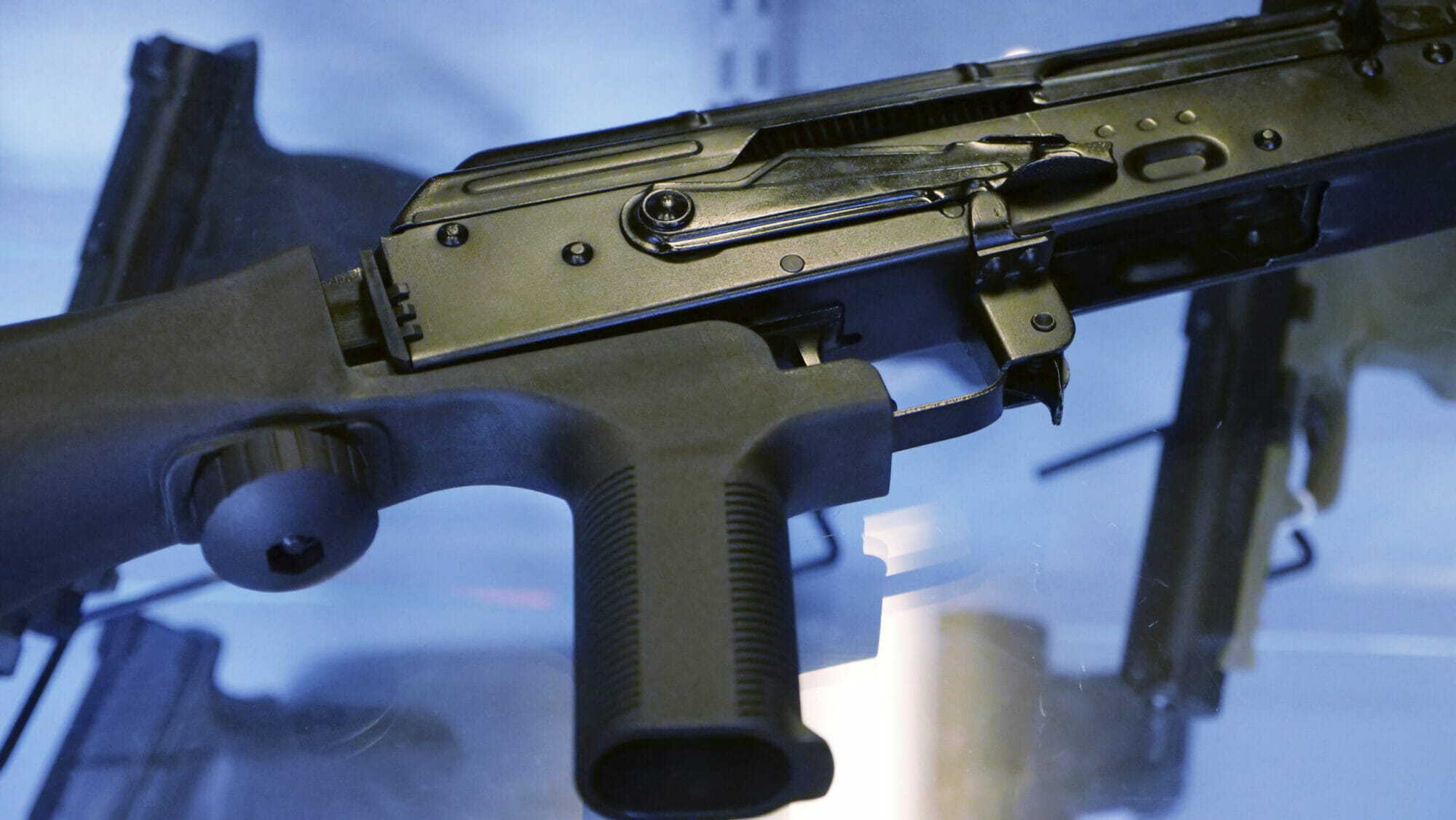
To circumvent the significant restrictions on machine guns, the gun industry has marketed devices that can be attached to semi-automatic firearms and accelerate the weapon’s rate of fire to rates approaching automatic machine gun fire. These devices, including bump-fire (or bump stock) and trigger crank devices, were designed to skirt the limits of federal law because historically they were not considered machine guns under federal law.
Bump-fire devices replace a semi-automatic rifle’s standard shoulder stock and allow the weapon to smoothly slide (or “bump”) back and forth very rapidly between the shooter’s shoulder and trigger finger. By harnessing the weapon’s recoil or kickback, the bump stock causes the trigger to be engaged many times faster than a human could otherwise fire. In October 2017, a gunman in Las Vegas used multiple bump fire devices to convert semi-automatic rifles into weapons that fired nine shots per second. He used those weapons to carry out the deadliest mass shooting attack in modern American history. In response to this shooting, effective March 26, 2019, the ATF amended its regulations and now classifies bump stocks as machine guns, effectively banning them.
Trigger cranks attach to a firearm’s trigger guard and similarly enable a shooter to repeatedly pull the trigger in very rapid succession by simply rotating the crank. Unlike bump stocks, trigger cranks are not classified as ‘machine guns’ by the ATF, and are thus still legal to own in most states.
Learn more about bump stocks, trigger activators, and other deadly accessories in our report Legal and Lethal: Nine Products that Could Be the Next Bump Stock.
50 Caliber Rifles
Fifty caliber rifles are among the most destructive weapons that may be manufactured and made legally available to civilians in the United States. Only four states and Washington DC place any additional regulation on these weapons. Fifty caliber rifles are military firearms, used by armed forces across the globe, that combine long range, accuracy, and massive firepower.2 A 50 caliber rifle can hit a target accurately from distances of 1,000 to 2,000 yards, depending on the skill of the shooter, and can reach targets at an even longer range, sacrificing accuracy.3 This is more than twice the average effective range of an AR-15, a popular assault rifle.4 Designed for use in urban combat situations, 50 caliber rifles can penetrate structures and destroy or disable light armored vehicles, radar dishes, helicopters, stationary, and taxiing airplanes, and other “high-value” military targets.5
50 caliber rifles can be particularly dangerous when made available on the open market, with law enforcement reports tying their use to terrorism, domestic drug trafficking, and other violent crime.6However, because 50 caliber rifles are generally regulated no differently from other rifles or shotguns, they are subject to less regulation than handguns in most states and under federal law.7 In fact, under federal law and the laws of nearly all states, any 18-year-old who passes a background check can buy a 50 caliber rifle.8 In addition, because federal law and the laws of most states do not require private sellers to conduct background checks, criminals can easily obtain 50 caliber rifles at gun shows and elsewhere.
The destructive power of the 50 caliber rifle can be magnified by the use of certain types of ammunition that are legal under federal law (although banned in some states). In addition to the standard “ball” round of 50 caliber ammunition, armor-piercing, incendiary, and combination armor-piercing and incendiary ammunition for 50 caliber rifles can significantly enhance their destructive capacity,9 particularly against chemical and industrial facilities10 and civil aviation targets.11 For more information, see our page on Ammunition Regulation.
Like machine guns, 50 caliber rifles are extremely destructive military weapons, and they should be regulated accordingly.
Summary of Federal Law
Federal legislation to regulate or ban 50 caliber rifles has been introduced several times since 1999, but these efforts have been unsuccessful—no federal law regulates these guns.
Federal Definition of a Machine Gun
For purposes of federal law, a “machinegun” is defined as:
“[A]ny weapon which shoots, is designed to shoot, or can be readily restored to shoot, automatically more than one shot, without manually reloading, by a single function of the trigger. The term shall also include the frame or receiver of any such weapon, any part designed and intended solely and exclusively, or combination of parts designed and intended, for use in converting a weapon into a machinegun, and any combination of parts from which a machinegun can be assembled if such parts are in the possession or under the control of a person.”12
In response to the use of bump stocks in the Las Vegas shooting in October 2017, ATF began the process to include bump stocks within the definition of “machinegun.” ATF finalized the regulation in December 2018. It clarifies that:
“For purposes of this definition, the term “automatically” as it modifies “shoots, is designed to shoot, or can be readily restored to shoot,” means functioning as the result of a self-acting or self-regulating mechanism that allows the firing of multiple rounds through a single function of the trigger; and “single function of the trigger” means a single pull of the trigger and analogous motions. The term “machinegun” includes a bump-stock-type device, i.e., a device that allows a semi- automatic firearm to shoot more than one shot with a single pull of the trigger by harnessing the recoil energy of the semi-automatic firearm to which it is affixed so that the trigger resets and continues firing without additional physical manipulation of the trigger by the shooter.”13
Federal Machine Gun Laws Allow Possession of Pre-1986 Models
The federal government first acted to regulate machine guns with the National Firearms Act of 1934. This law imposed a special tax on machine guns that was designed to curtail their sale and possession, and also required registration of machine guns. Later, Congress enacted a stricter law—The Firearm Owners’ Protection Act of 1986—banning the possession and transfer of new machine guns. However, this law exempts machine guns manufactured prior to May 19, 1986, as well as machine guns possessed by or manufactured for governmental entities.
The relevant features of both laws are summarized below.
The Firearm Owners’ Protection Act of 1986
On May 19, 1986, as part of the Firearm Owners’ Protection Act (FOPA), Congress banned the transfer and possession of machine guns with two exceptions, described below.14
Exceptions to the Federal Machine Gun Ban
The first exception to the federal machine gun ban is that machine guns lawfully possessed prior to May 19, 1986 may continue to be possessed and transferred, provided they are registered in accordance with requirements of the National Firearms Act of 1934 (NFA).15 The second exception is that machine guns may be transferred to or by, or possessed by or under the authority of, the federal government or a state, or a department, agency, or political subdivision thereof.16
As a result of FOPA, a person may not make, manufacture, or import a machine gun unless it is for a government entity.17 (Although there is no explicit ban on manufacturing machine guns, FOPA’s ban on possession of newly manufactured machine guns makes it impossible to manufacture a machine gun lawfully, unless it is specifically intended for a governmental entity.) Unregistered machine guns are contraband, and there is no way to register a previously unregistered machine gun.18
Machine Gun Manufacturers, Importers, and Dealers Must Be Registered
Under FOPA, each person or entity engaged in business as an importer, manufacturer, or dealer of machine guns must register with ATF as a Class 1, 2, or 3 licensee, respectively.19 Any importer, manufacturer, or dealer of machine guns must pay a “special occupational tax” for each place of business of $1,000 a year.20
As a result of FOPA, machine guns may only be imported by a registered importer, and only if they are being imported for sale or distribution to a federal or state agency or political subdivision thereof, or for use by a registered dealer as a sales sample.21 The earlier federal law addressing machine guns, the National Firearms Act of 1934, requires anyone importing a machine gun to first obtain authorization from, and register the machine gun with, ATF.22 It is unlawful for any person to receive or possess a machine gun that was imported in violation of the NFA.23
Similarly, as a result of FOPA, machine guns may only be manufactured by a registered manufacturer, and only if they are being manufactured for sale or distribution to a federal, state, or local agency, for use by a registered dealer as a sales sample, or for exportation.24 The National Firearms Act of 1934 also requires anyone manufacturing a machine gun to register it with ATF.25
Under FOPA, applications to transfer and register machine guns manufactured or imported after May 19, 1986 to a registered machine gun dealer as sales samples will be approved only if the manufacturer or importer establishes by specific information:
- The expected governmental customers who would require a demonstration of the weapon;
- The availability of the machine gun to fill subsequent orders;
- A need for a particular model or interest in seeing a demonstration of a particular weapon, as expressed in letters from governmental entities; and
- The dealer’s need for the quantity of samples sought to be transferred (if more than one).26
The exportation of machine guns is also regulated.27 Where ATF has issued a permit to export a machine gun, the exporter must furnish proof of the exportation of the machine gun within six months from issuance of the permit.28
“Makers” of Machine Guns Must Be Registered and Pay a Tax
Under the federal machine gun laws, the term “make” includes manufacturing (by someone other than by a manufacturer registered under the National Firearms Act of 1934), putting together, altering, any combination of these, or otherwise producing a machine gun.29 The National Firearms Act of 1934 requires anyone making a machine gun to register it with ATF.30 It is unlawful for any person to make a machine gun, or receive or possess a machine gun that was made, in violation of the National Firearms Act of 1934.31
As a result of FOPA,32 applications to make and register machine guns made on or after May 19, 1986 will be approved only if it is established by specific information that the machine gun is particularly suitable for use by federal, state, or local governmental entities and that the making of the weapon is at the request and on behalf of such an entity.33
A person making a machine gun must pay a $200 tax for each machine gun made.34 However, ATF may make exceptions to this tax in certain circumstances.35
SUPPORT GUN SAFETY
We’re in this together. To build a safer America—one where children and parents in every neighborhood can learn, play, work, and worship without fear of gun violence—we need you standing beside us in this fight.

National Firearms Act of 1934
The National Firearms Act of 1934 (NFA) taxes the making and transfer of machine guns and certain other weapons. It also imposes an occupational tax on persons and entities that are in the business of importing, manufacturing, and dealing in those weapons. (The NFA distinguishes between “making” a weapon, and “manufacturing” a weapon. Only a registered NFA manufacturer can “manufacture” a machine gun; other persons who construct machine guns are “making” them, according to the NFA.36 As detailed below, the law also requires the registration of all machine guns and machine gun transfers, requires that machine guns have serial numbers, regulates the transportation of machine guns, provides for record-keeping by the ATF, and provides for seizure of unregistered machine guns.
$200 Machine Gun Tax
While the NFA was enacted by Congress as an exercise of its authority to tax, the law also served to curtail transactions in machine guns and certain other weapons.37 Congress found that these firearms jeopardize the public because of their frequent use in crime.38 The $200 tax on the making or transfer of these weapons was considered quite severe at the time, and adequate to discourage or eliminate transfers of machine guns.39 The $200 tax has not changed since 1934.
Central Registry of Machine Guns
The NFA requires anyone manufacturing, making, importing, or transferring a machine gun (or certain other weapons also regulated by the NFA) to register it with the Secretary of the Treasury.40 The NFA then requires the Secretary to maintain a central registry of all of these weapons that are “not in the possession or under the control of the United States,”41 meaning that the central registry includes machine guns owned by state, or local entities, as well as those legally owned by private persons.
The Secretary has delegated the responsibility for maintaining this registry to the National Firearms Act Branch of the ATF.42 The registry is known as the National Firearms Registration and Transfer Record.43 For each registered machine gun, the ATF’s registry includes:
- An identification of the machine gun, including serial number; name and address of the manufacturer, maker, or importer, if known; model; caliber, gauge or size; and any other identifying marks on the firearm;
- The date of registration; and
- The identification and address of the person entitled to possess the machine gun.44
A person possessing a machine gun must retain proof of registration, which shall be made available to ATF upon request.45
In 2007, the Office of the Inspector General issued a report finding that management and technical deficiencies have created errors in the machine gun registry and limited ATF’s ability to adequately address those errors. ATF staff has not processed applications or entered database information uniformly, causing errors in records, reports, and queries, as well as inconsistent decisions on NFA weapons registration and transfer applications. Further, ATF was not timely in correcting errors and discrepancies in the registry after problems were identified by ATF investigators during compliance inspections of federal firearms licensees.46
Machine Gun Transfers Must Be Registered
With limited exceptions, the NFA requires anyone transferring a machine gun to register it with ATF. (The NFA put this responsibility, along with the $200 tax discussed below, on the transferor, rather than the transferee, in an effort to deter all transfers of machine guns.47) The term “transfer” includes selling, assigning, pledging, leasing, loaning, giving away, or otherwise disposing of the machine gun.48 In order to register a machine gun for transfer, a transferor must get authorization from ATF.49
ATF may not deny a transfer of a previously registered machine gun unless: (1) a federally licensed manufacturer, importer, dealer, or collector is transferring a machine gun to an unlicensed person;50 or (2) the transfer, receipt, or possession of the machine gun would place the transferee in violation of federal, state, or local law.51 As a result, ATF regulations require a law enforcement officer to certify that the receipt and possession of the firearm will not place the transferee in violation of state or local law.52 Note that federal law generally prohibits transfers of all firearms across state lines unless the transferee is a federally licensed manufacturer, importer, dealer, or collector, so ATF will also generally not approve interstate transfers.53
Due to a 1968 change in the law, it is illegal for any federally licensed manufacturer, importer, dealer, or collector to sell or deliver a machine gun, except as specifically authorized by the Attorney General “consistent with public safety and necessity.” This provision does not apply if the recipient is another federally licensed manufacturer, importer, dealer, collector, or research organization designated by the Attorney General.54 The Attorney General has delegated enforcement of this provision to ATF, which requires that an entity selling or delivering a machine gun to a member of the public first obtain from the recipient a sworn statement providing: (1) the reasons why there is a reasonable necessity for such person to acquire the machine gun, and (2) that such person’s receipt or possession of the machine gun would be consistent with public safety.55
It is unlawful to take possession of a machine gun unless ATF has approved the transfer and registration of the firearm to the new possessor.56 Note that the NFA also requires the transferor of a machine gun to pay a $200 tax for each transfer.57 ATF may make exceptions to this tax in certain circumstances.58
Transportation of Machine Guns
It is illegal for anyone other than a federally licensed manufacturer, importer, dealer, or collector59 to transport a machine gun in interstate or foreign commerce except as specifically authorized by the Attorney General, through ATF, consistent with public safety and necessity.60 It is also illegal to transport, deliver, or receive a machine gun in interstate commerce that has not been registered in accordance with the NFA.61
Machine Guns Must Have Identifying Marks
The NFA requires anyone manufacturing, importing, or making a machine gun to identify it by:
- A serial number which may not be readily removed, obliterated, or altered;
- The name of the manufacturer, importer, or maker; and
- Any other identification as the secretary by regulation has prescribed.62
A person who possesses a machine gun that lacks this information must identify it with a serial number and other information as ATF prescribes.63
It is unlawful for any person to receive or own a machine gun that is not identified by a serial number as required by the NFA or that has the serial number or other identification required by the NFA obliterated, removed, changed, or altered.64
Record-Keeping and Reporting Regulations
The NFA gives ATF authority to prescribe regulations requiring importers, manufacturers, and dealers to keep records of the importation, manufacture, making, receipt, sale, or other disposition of machine guns.65 Whenever any machine gun is stolen or lost, the person losing possession must immediately upon discovery of the theft or loss make a report to ATF.66 The NFA prohibits knowingly making or causing to make a false entry in any application, return, or record required by the NFA.67
The NFA prohibits using information obtained from an application, registration, or records required to be submitted or retained by a natural person to comply with the NFA as evidence against the person in a criminal proceeding for a violation of law prior to or simultaneous with the application, registration, or records.68 However, this information may be used in a prosecution for furnishing false information.69
ATF officers are authorized to enter during business hours the premises and storage rooms of any manufacturer, importer, or dealer of machine guns, to examine any books, papers, or records required to be kept by the NFA or implementing regulations, as well as any machine guns kept by such manufacturer, importer, or dealer on such premises.70 ATF may also require the production, of any books, papers, or records necessary to determine the observance of these laws.71
Seizure of Unregistered Machine Guns
Any machine gun involved in a violation of the NFA is subject to seizure and forfeiture. Forfeited machine guns cannot be sold at public sale, but may be destroyed or transferred within the federal government, or to a state or local government.72
Summary of State Law
Machine Guns
While federal law places minimal restrictions on machine guns, a number of states have gone over and above federal law in regulating these military-style weapons.
States that Prohibit the Possession, Manufacture, or Sale of Machine Guns
The strongest state laws generally prohibit the possession, manufacture, or sale of all machine guns, including machine guns that are possessed, manufactured, or sold in compliance with federal law. The following 15 states, as well as the District of Columbia, have such laws:
State Machine Gun Regulations
| State | Prohibit Possession | Prohibit Manufacture | Prohibit Sale |
|---|---|---|---|
| California73 | Yes | Yes | Yes |
| Colorado74 | Yes | No | No |
| Delaware75 | Yes | Yes | Yes |
| District of Columbia | Yes76 | No | Yes77 |
| Hawaii78 | Yes | Yes | Yes |
| Illinois79 | Yes | Yes | Yes |
| Iowa80 | Yes | No | No |
| Louisiana81 | Yes | No | Yes |
| Maryland82 | Yes* | No | No |
| Massachusetts | Yes83 | No | Yes84 |
| Minnesota85 | Yes | No | No |
| Montana86 | Yes* | No | No |
| New Jersey | Yes87 | Yes88 | Yes89 |
| New York | Yes90 | Yes91 | No |
| Rhode Island92 | Yes | Yes | Yes |
| Virginia 93 | Yes* | No | No |
| Wisconsin 94 | Yes | No | Yes |
States with Minimal or No Regulations of Machine Guns
The remaining 35 states only regulate machine guns that are possessed in violation of federal law or do not impose any state-level regulations:
- Twenty-five states impose criminal penalties only when individuals manufacture, possess, or sell machine guns in violation of federal law.95
- Five states—Idaho, Oklahoma, Utah, Vermont, and Wyoming—regulate the possession of machine guns in other limited circumstances such as prohibiting the possession of machine guns by minors.96
- Five states—Alabama, Kentucky, Mississippi, New Hampshire, and New Mexico—do not have any state-level regulations of machine guns.
GET THE FACTS
Gun violence is a complex problem, and while there’s no one-size-fits-all solution, we must act. Our reports bring you the latest cutting-edge research and analysis about strategies to end our country’s gun violence crisis at every level.
Learn More
Bump Stocks, Trigger Cranks, and other devices designed to simulate machine gun fire
Eighteen states and the District of Columbia have taken steps to increase security regarding the use of bump stocks and trigger activators. Because each state defines these devices differently, these laws vary in strength.
California
California bans the possession, manufacture, import, sale, gift or lease of “multiburst trigger activator[s]”97, defined as:
- “A device designed or redesigned to be attached to, built into, or used in conjunction with, a semiautomatic firearm, which allows the firearm to discharge two or more shots in a burst by activating the device.
- A manual or power-driven trigger activating device constructed and designed so that when attached to, built into, or used in conjunction with, a semiautomatic firearm it increases the rate of fire of that firearm.”98
The penalty for possession is imprisonment for up to one year.99
Connecticut
Connecticut bans the possession, manufacture, sale or transfer of “rate of fire enhancement[s]”, defined as:
“[A]ny device, component, part, combination of parts, attachment or accessory that:
- Uses energy from the recoil of a firearm to generate a reciprocating action that causes repeated function of the trigger, including, but not limited to, a bump stock;
- repeatedly pulls the trigger of a firearm through the use of a crank, lever or other part, including, but not limited to, a trigger crank; or
- causes a semiautomatic firearm to fire more than one round per operation of the trigger, where the trigger pull and reset constitute a single operation of the trigger, including, but not limited to, a binary trigger system.”100
Violation of this section is a class D misdemeanor for people who have firearms permits or eligibility certificates, and a class D felony for those who do not.101
Delaware
Delaware bans the manufacture, possession, sale, and transfer of bump stocks, trigger cranks and rapid fire devices.
- “Bump stock” means an after-market device that increases the rate of fire achievable with a semi-automatic rifle by using energy from the recoil of the weapon to generate a reciprocating action that facilitates repeated activation of the trigger.
- “Trigger crank” means an after-market device designed and intended to be added to a semi-automatic rifle as a crank operated trigger actuator capable of triggering multiple shots with a single rotation of the crank.102
- “Rapid fire device” means a part, kit, tool, accessory, or device that increases the rate of fire of a semi-automatic firearm to a rate of fire that mimics the rate of fire of a machine gun.
District of Columbia
D.C. bans the possession of bump stocks.103 A bump stock is defined as “any object that, when installed in or attached to a firearm, increases the rate of fire of the firearm by using energy from the recoil of the firearm to generate a reciprocating action that facilitates repeated activation of the trigger.”104
Florida
Florida bans the possession, sale, and transfer of “bump-fire stock[s]”, defined as:
“[A] conversion kit, a tool, an accessory, or a device used to alter the rate of fire of a firearm to mimic automatic weapon fire or which is used to increase the rate of fire to a faster rate than is possible for a person to fire such semiautomatic firearm unassisted by a kit, a tool, an accessory, or a device.”105
Violation of this section is a felony of the third degree. Though Florida bans only bump stocks by name, the definition of bump-fire stocks is broad enough to include other devices that enhance the rate of semiautomatic firearms.
Hawaii
In 2018, Hawaii prohibited the manufacture, sale, or possession of bump stocks which are defined as “a butt stock designed to be attached to a semiautomatic firearm and designed… to increase the rate of fire… by using energy from the recoil of the firearm to generate a reciprocating action that facilitates repeated activation of the trigger.”3
Hawaii also prohibits two additional types of trigger activators:4
(A) “Trigger cranks,” defined as “any device to be attached to a semiautomatic firearm that repeatedly activates the trigger of the firearm through the use of a lever or other part that is turned in a circular motion…” and
(B) “Multiburst trigger activators,” which are
(1) Devices that simulate automatic gunfire by allowing standard function of a semiautomatic firearm with a static positioned trigger finger or a device that fires multiple shots with the pull and release of the trigger; or
(2) Manual or power-driven trigger activating devices constructed and designed so that when attached to a semiautomatic firearm they simulate automatic gunfire.
Iowa
Iowa bans the sale of “a manual or power-driven trigger activating device constructed and designed so that when attached to a firearm [it] increases the rate of fire of the firearm.”106
Illinois
Illinois passed legislation in early 2023—as part of a broad comprehensive bill regulating the availability of assault weapons, .50 caliber rifles, and large capacity magazines—to restrict the manufacture, sale, offer to sale, possession, purchase, importation, transfer, or use of any device, part, kit, tool, accessory, or combination of parts that is designed to and functions to increase the rate of fire of a semiautomatic firearm above the standard rate of fire for semiautomatic firearms not equipped with such a device or part(s).107
Indiana and Louisiana
In 2023, Indiana and Louisiana banned possession of trigger activators by stating that only weapons that do not have to be registered as part of the National Firearms Act are exempt from the prohibition on machine guns. Since the Bureau of Alcohol, Tobacco, Firearms & Explosives defines trigger activators as machine guns and thus requires them to be registered, they can no longer be possessed in Indiana.108
Maryland
Maryland bans the possession, sale, transfer, or transportation of rapid fire trigger activators.
“Rapid fire trigger activator” means any device, including a removable manual or power-driven activating device, constructed so that, when installed in or attached to a firearm:
- the rate at which the trigger is activated increases; or
- the rate of fire increases.”109
Violation of this section is a misdemeanor. Maryland offers an exception to this restriction for those who have applied for authorization from the federal Bureau of Alcohol, Tobacco, Firearms and Explosives (ATF) before October 1, 2018. Effective October 1, 2019, this exception will apply only to those who have received authorization from ATF by that date.110
Massachusetts
Massachusetts bans possession of bump stocks and trigger cranks as part of its machine gun ban.
- ‘Machine gun’, a weapon of any description, … ; provided, however, that ‘machine gun’ shall include bump stocks and trigger cranks.111
- Whoever, except as provided by law112, possesses a machine gun, … , shall be punished by imprisonment in the state prison for life, or for any term of years …113
Minnesota
Minnesota bans114 the ownership, possession, or operation of a trigger activtor which is defined as:
- A removable manual or power driven trigger activating device constructed and designed so that, when attached to a firearm, the rate at which the trigger may be pulled increases and the rate of fire of the firearm increases to that of a machine gun; or
- A device that allows a semiautomatic firearm to shoot more than one shot with a single pull of the trigger or by harnessing the recoil of energy of the semiautomatic firearm to which it is affixed so that the trigger resets and continues firing without additional physical manipulation of the trigger.115
Nevada
Nevada prohibits devices, parts or combinations of parts, and modifications to firearms that eliminate the need for the operator of a semiautomatic firearm to make a separate movement for each individual function of the trigger and:
- Materially increases the rate of fire of the semiautomatic firearm; or
- Approximates the action or rate of fire of a machine gun.116
New Jersey
New Jersey bans the possession of bump stocks and trigger cranks.117
- ‘Bump stock’ means any device or instrument for a firearm that increases the rate of fire achievable with the firearm by using energy from the recoil of the firearm to generate a reciprocating action that facilitates repeated activation of the trigger.
- ‘Trigger crank’ means any device or instrument to be attached to a firearm that repeatedly activates the trigger of the firearm through the use of a lever or other part that is turned in a circular motion; provided, however, the term shall not include any weapon initially designed and manufactured to fire through the use of a crank or lever.118
Possession is a crime of the third degree. This ban, due to the narrow definitions of bump stock and trigger crank, does not ban all devices that can increase firing rate.119
Rhode Island
Rhode Island bans bump stocks and trigger cranks as well as other devices that increase the rate of fire of semiautomatic firearms:
- It shall be unlawful for any person to possess a bump-fire device, binary trigger, trigger crank, or any other device that when attached to a semi-automatic weapon allows full-automatic fire.120 Those who violate this section are subject to one to ten years of imprisonment of a fine of up to $10,000.121
Vermont
In Vermont, a “bump-fire stock” means a butt stock designed to be attached to a semiautomatic firearm and intended to increase the rate of fire achievable with the firearm to that of a fully automatic firearm by using the energy from the recoil of the firearm to generate a reciprocating action that facilitates the repeated activation of the trigger. Possession of a bump-fire stock is prohibited.122
Virginia
Virginia bans the manufacture, importation, sale, possession, transfer, and transportation of any device designed to convert a semi-automatic firearm to shoot more than one shot by a single function of the trigger.123 This includes bump stocks and trigger cranks. Violation of the this law is punishable as a felony.124
Washington
In 2018 Washington prohibited any person from manufacturing, owning, buying, selling, loaning, furnishing, transporting, or having in his or her possession or under his or her control “bump-fire stocks.”7 Washington defines a “bump-fire stock” as “a butt stock designed to be attached to a semiautomatic firearm with the effect of increasing the rate of fire achievable with the semiautomatic firearm to that of a fully automatic firearm by using energy from the recoil of the firearm to generate a reciprocating action that facilitates repeated activation of the trigger.”8
50 Caliber
Certain states have taken steps to increase security regarding the use of 50 caliber weapons. California, Illinois, New Jersey, and the District of Columbia generally ban .50 caliber rifles, while Connecticut bans a single model of .50 caliber rifle. Maryland imposes various regulations on transfers of 50 caliber rifles. Despite the risks inherent in the use of 50 caliber handguns, no state bans 50 caliber handguns as of yet. For laws banning fifty caliber cartridges, see our summary on Ammunition Regulation.
California .50 Caliber Ban
Prohibited Activities: California’s .50 caliber ban prohibits a wide range of activities. It applies to manufacture, possession, distribution, and importation of 50 caliber rifles, as well as sale, offering for sale, and transfer.125
Definition of Banned Weapon: California’s ban on .50 caliber rifles defines the banned weapons based on the type of cartridge they are capable of firing. California’s ban prohibits “50 caliber BMG rifles,” which are defined as any “center fire rifle that can fire a .50 BMG cartridge.” A BMG cartridge is then defined in detail based on specific length and diameter.126
Legacy Weapons: California’s law provides that in order to retain possession of a 50 caliber rifle, any person who lawfully possessed that weapon prior to January 1, 2005 must have registered it no later than April 30, 2006.127
Connecticut Ban on One .50 caliber Model
Connecticut bans the possession, distribution, importation, transportation, and keeping or offering for sale of the “Barrett Light-Fifty model 82A1,” which is included in the state’s definition of assault weapon.128 Connecticut required the registration of assault weapons that were owned prior to the ban’s enactment.129
DC’s .50 Caliber Ban
The District of Columbia deems .50 BMG rifles unregisterable, thereby prohibiting the possession, sale, or other transfer of these firearms.130 The District does not allow the continued possession of such rifles that were possessed prior to the ban’s enactment.
Illinois’ .50 caliber ban
In January 2023, Illinois enacted legislation to generally ban commerce and possession of .50 caliber rifles as part of the state’s larger ban on assault weapons.131 The law now generally restricts these rifles the same way Illinois law treats assault weapons. Subject to narrow exceptions,132 this law made it immediately unlawful to knowingly manufacture, deliver, sell, import, or purchase a fifty caliber rifle, or to cause another person to manufacture, deliver, sell, import, or purchase a fifty caliber rifle.133
The law also generally makes it unlawful to knowingly possess a fifty caliber rifle in the state after January 1, 2024.134 The law provides an exception for people to remain in continued possession of a fifty caliber rifle they legally obtained and possessed before the assault weapons law went into effect, if they comply with a set of requirements and limitations on public use and carry.135 People who wish to qualify for this exemption and remain in lawful possession of a fifty caliber rifle are required to electronically submit an endorsement affidavit form to the Illinois State Police by October 1, 2023, with specified information including the weapon’s make, model, and serial number and the person’s Firearm Owner’s Identification (FOID) Card number.136 The law also includes limitations to generally prevent these weapons from being used or carried in most public locations. Beginning April 10, 2023, (90 days after the effective date of the assault weapons law), Illinois law generally permits people to possess a fifty caliber rifle (or an assault weapon) only on their own private property, or with the express permission of another person to carry on private property that is not open to the public, or in certain other designated locations such as a licensed firing range, or while traveling to or from these permissible locations if the weapon is kept unloaded and enclosed in a case or container during transport.137
Maryland .50 caliber Regulations
Maryland is the only other state that in some manner regulates 50 caliber rifles. The state includes the “Barrett light .50 cal. semi-auto” in the list of assault weapons defined as “regulated firearms.” Transfers of regulated firearms in Maryland are subject to enhanced background checks, minimum age restrictions, and waiting periods. Moreover, firearms dealers and private or secondary market sellers must comply with additional regulations when transferring a regulated firearm, and purchasers are limited to the purchase of one regulated firearm per month.138
New Jersey .50 caliber ban
New Jersey prohibits the possession of “destructive devices” which include any center-fire rifle that is capable of firing a .50 BMG cartridge.139 A .50 BMG cartridge” means a cartridge that is designed and intended to be fired from a center-fire rifle and that meets all of the following criteria:
- It has an overall length of 5.54 inches from the base to the tip of the bullet;
- The bullet diameter for the cartridge is from .510 inches to and including .511 inch;
- The case base diameter for the cartridge is from .800 inches to and including .804 inch; and
- The cartridge case length is 3.91 inches.140
Key Legislative Elements
The features listed below are intended to provide a framework from which policy options may be considered. A jurisdiction considering new legislation should consult with counsel.
- Prohibition on manufacture, import, sale, offering for sale, transfer, and possession of machine guns, .50 caliber firearms, and devices including but not limited to bump stocks designed to increase the rate of fire of a semiautomatic firearm
- The definition of trigger activator (or equivalent term) should be broad enough to encompass all devices that are designed and function to materially increase the rate of fire of a semiautomatic firearm
RELATED
Assault Weapons
Large Capacity Magazines
Universal Background Checks
- “Firearms Commerce in the United States Annual Statistical Update 2021,” Bureau of Alcohol, Tobacco, Firearms and Explosives, 2021, https://www.atf.gov/firearms/docs/report/2021-firearms-commerce-report/download For more information about what constitutes a “machine gun,” see Bureau of Alcohol, Tobacco, Firearms and Explosives, “National Firearms Act Handbook,” U.S. Department of Justice (June 2007): 9-15.[↩]
- Tom Diaz, “Voting From the Rooftops: How the Gun Industry Armed Osama bin Laden, Other Foreign and Domestic Terrorists, and Common Criminals with 50 Caliber Sniper Rifles,” Violence Policy Center (Oct. 2001): 7-12, http://www.vpc.org/graphics/rooftop.pdf.[↩]
- Id.[↩]
- This applies to AR-15s firing .223 ammunition, the most common round used in this type of weapon. Brad Sylvester, “Fact Check: David Hogg Says The Ar-15 Has An Effective Range Of More Than 1,500 Meters,” Check Your Fact, February 24, 2019, https://checkyourfact.com/2019/02/24/fact-check-ar-15-effective-range-1500-meters/.[↩]
- Tom Diaz, “Clear and Present Danger: National Security Experts Warn About the Danger of Unrestricted Sales of 50 Caliber Anti-Armor Sniper Rifles to Civilians,” Violence Policy Center (July 2005), http://www.vpc.org/studies/50danger.pdf.[↩]
- Office of Special Investigations, “Weaponry: Availability of .50 Caliber Semiautomatic Rifles,” U.S. General Accounting Office (June 30, 1999): 6-7, http://www.gao.gov/assets/90/88915.pdf. See also “Criminal Use of the 50 Caliber Sniper Rifle Fact Sheet,” Violence Policy Center, Accessed June 24, 2019, http://www.vpc.org/regulating-the-gun-industry/criminal-use-of-50-caliber/; Tom Diaz, “Iron River: Gun Violence and Illegal Firearms Trafficking on the U.S.-Mexico Border,” Violence Policy Center (Apr. 2009): 20, http://www.vpc.org/studies/ironriver.pdf. See Colby Goodman & Michel Marizco, “U.S. Firearms Trafficking to Mexico: New Data and Insights Illuminate Key Trends and Challenges, in Shared Responsibility: U.S.-Mexico Policy Options for Confronting Organized Crime,” Woodrow Wilson International Center for Scholars (Eric L. Olson, David A. Shirk & Andrew Selee eds., 2010): 187, http://www.wilsoncenter.org/sites/default/files/Shared%20Responsibility%2012.22.10.pdf.[↩]
- Office of the Inspector General, “The Bureau of Alcohol, Tobacco, Firearms and Explosives’ National Firearms Registration and Transfer Record, Evaluation and Inspections Report I-2007-006,” U.S. Department of Justice (June 2007), http://www.usdoj.gov/oig/reports/ATF/e0706/back.htm. For more information about what constitutes a “machine gun,” see Bureau of Alcohol, Tobacco, Firearms and Explosives, “National Firearms Act Handbook,” U.S. Dept. of Justice (June 2007): 9-15. Violence Policy Center, “One Shot, One Kill: Civilian Sales of Military Sniper Rifles,” (Bill McGeveran & Aimée Stenzel eds., May 1999): 41-42, http://www.vpc.org/graphics/snipcov2.pdf; “Voting from the Rooftops,” supra note 1, at 62-68. Note that while most of the data regarding 50 caliber weapons relates to rifles (which are regulated as long guns), the industry also has introduced 50 caliber handguns. Smith & Wesson, for example, manufactures a handgun that can fire a 50 caliber round and that may be capable of penetrating the highest grade of concealable body armor typically worn by law enforcement officers. Tom Diaz, “Vest Buster: The .500 Smith & Wesson Magnum – The Gun Industry’s Latest Challenge to Law Enforcement Body Armor,” Violence Policy Center (Aimée Newth ed., June 2004): 19, http://www.vpc.org/graphics/S&W500%20final.pdf.[↩]
- 18 U.S.C. § 922(b)(1), (c)(1). By contrast, only adults age 21 or older may buy a handgun from a federally licensed dealer. 18 U.S.C. § 922(x)(1), (3), (5).[↩]
- “Voting From the Rooftops,” supra note 1, at 12-20.[↩]
- See “Sitting Ducks: The Threat to the Chemical and Refinery Industry from 50 caliber Sniper Rifles,” Violence Policy Center (Aug. 2002), http://www.vpc.org/studies/duckcont.htm.[↩]
- See Tom Diaz, “Just Like Bird Hunting: The Threat to Civil Aviation From 50 Caliber Sniper Rifles,” Violence Policy Center (Aimée Stenzel ed., Jan. 2003), http://www.vpc.org/graphics/birdhuntingstudy.PDF.[↩]
- 18 U.S.C. § 921(a)(23). See also 26 U.S.C. § 5845(b).[↩]
- Bureau of Alcohol, Tobacco, Firearms, and Explosives, Bump-Stock-Type Devices, Final Rule (to be codified at 27 C.F.R. § 447.11, 478.11, 479.11), https://www.atf.gov/rules-and-regulations/bump-stocks (last visited Dec. 19, 2018).[↩]
- 18 U.S.C. § 922(o).[↩]
- 18 U.S.C. § 922(o)(2)(B). See also 26 U.S.C. § 5861(d); 27 C.F.R. §§ 478.36, 479.105.[↩]
- 18 U.S.C. § 922(o)(2)(A); 27 C.F.R. §§ 478.36, 479.105.[↩]
- 27 C.F.R. § 479.105.[↩]
- Bureau of Alcohol, Tobacco, Firearms and Explosives, U.S. Dept. of Justice, National Firearms Act Handbook 25, June 2007. State and local police organizations may register machine guns acquired through seizure, forfeiture, or abandonment. Id. at 23.[↩]
- 26 U.S.C. § 5802; 27 C.F.R. § 479.31 et seq. An “importer” is any person who is engaged in the business of importing, or bringing firearms into the United States. 26 U.S.C. § 5845(l). A “manufacturer” is any person who is engaged in the business of manufacturing machine guns. 26 U.S.C. § 5845(m). A “dealer” is any person, not a manufacturer or importer, who is engaged in the business of selling, renting, leasing, or loaning machine guns and includes pawnbrokers who accept machine guns as collateral for loans. 26 U.S.C. § 5845(k).[↩]
- 26 U.S.C. § 5801; 27 C.F.R. § 479.31 et seq. If the importer’s or manufacturer’s gross receipts per taxable period are less than $500,000, this tax may be reduced to $500. It is illegal to engage in business as an importer, manufacturer, or dealer of machine guns without having paid this tax or registered with ATF. 26 U.S.C. § 5861(a).[↩]
- 18 U.S.C. § 922(o); 27 C.F.R. § 479.105(c). With respect to machine guns, the more lenient provisions of the National Firearms Act of 1934 regarding importation were superseded by the FOPA. See 26 U.S.C. § 5844.[↩]
- 26 U.S.C. § 5841(b). The procedure for getting ATF authorization for the importation of a machine gun and for registering a newly imported machine gun is set forth at 27 C.F.R. § 479.112.[↩]
- 26 U.S.C. § 5861(k).[↩]
- 18 U.S.C. § 922(o); 27 C.F.R. § 479.105(c).[↩]
- 26 U.S.C. § 5841(b). A manufacturer of a machine gun may register it by notifying ATF of the manufacture as ATF regulations prescribe. 26 U.S.C. § 5841(c). The procedure for obtaining authorization from ATF for the manufacturer of a machine gun and for registering a newly manufactured machine gun are available at 27 C.F.R. § 479.103.[↩]
- 27 C.F.R. § 479.105(d).[↩]
- See 27 C.F.R. §§ 479.110 et seq., 479.193.[↩]
- 27 C.F.R. § 479.118.[↩]
- 26 U.S.C. § 5845(i); 27 C.F.R. § 479.11.[↩]
- 26 U.S.C. § 5841(b). A maker of a machine gun may register it by obtaining authorization from ATF prior to making it in accordance with ATF regulations. 26 U.S.C. § 5841(c). The procedure for obtaining authorization from ATF for the making of a machine gun and for registering a newly made machine gun are available at 26 U.S.C. § 5822; 27 C.F.R. § 479.62 et seq.[↩]
- 26 U.S.C. § 5861.[↩]
- 18 U.S.C. § 922(o).[↩]
- 27 C.F.R. § 479.105(e).[↩]
- 26 U.S.C. § 5821; 27 C.F.R. § 479.61.[↩]
- 26 U.S.C. §§ 5851-5853.[↩]
- 26 U.S.C. § 5845(i); 27 C.F.R. § 479.11.[↩]
- National Firearms Act Handbook, supra note 21, at 1.[↩]
- Id.[↩]
- Id.[↩]
- 26 U.S.C. § 5841(b).[↩]
- 26 U.S.C. § 5841(a).[↩]
- As part of the Homeland Security Act of 2002, ATF was transferred from the Treasury Department to the Department of Justice, effective January 24, 2003. National Firearms Act Handbook, supra note 21, at 3.[↩]
- Bureau of Alcohol, Tobacco, Firearms and Explosives, U.S. Dept. of Justice, National Firearms Act, available at https://www.atf.gov/rules-and-regulations/national-firearms-act.[↩]
- 26 U.S.C. § 5841(a). See also 27 C.F.R. §§ 479.84, 479.101, 479.105.[↩]
- 26 U.S.C. § 5841(e); 27 C.F.R. § 479.101(e).[↩]
- Office of the Inspector General, US Department of Justice, Semiannual Report to Congress: Bureau of Alcohol, Tobacco, Firearms, & Explosives, April 1, 2007-September 30, 2007, available at: http://www.usdoj.gov/oig/semiannual/0711/atf.htm.[↩]
- National Firearms Act Handbook, supra note 21, at 1.[↩]
- 26 U.S.C. § 5845(j); 27 C.F.R. § 479.11.[↩]
- 26 U.S.C. § 5841(b). The procedure for getting authorization from ATF and registering a transferred machine gun is set forth at 26 U.S.C. § 5812(a); 27 C.F.R. § 479.84 et seq.[↩]
- See 18 U.S.C. § 922(b)(4).[↩]
- 26 U.S.C. § 5812(a).[↩]
- 27 C.F.R. § 479.85.[↩]
- 18 U.S.C. § 922(a)(3), (5), (b)(3); National Firearms Act Handbook, supra note 21, at 55.[↩]
- 18 U.S.C. § 922(b)(4).[↩]
- 27 C.F.R. §§ 478.98, 478.145.[↩]
- 26 U.S.C. §§ 5812(b), 5841(c). It is also unlawful to transfer a machine gun in violation of the NFA, or to receive or possess a machine gun that is not registered in compliance with the NFA, or that was transferred to the person in violation of the NFA. 26 U.S.C. § 5861.[↩]
- 26 U.S.C. § 5811.[↩]
- 26 U.S.C. §§ 5851-5853. As previously noted, taxable “transfers” include selling, assigning, pledging, leasing, loaning, giving away, or otherwise disposing of the machine gun. 26 U.S.C. § 5845(j); 27 C.F.R. § 479.11. However, when a machine gun is being transferred from the estate of a deceased person who lawfully possessed it to the person’s lawful heir, the transfer is not subject to the $200 tax, although the executor or administrator of the estate must still register the machine gun by seeking ATF’s approval prior to the transfer. National Firearms Act Handbook, supra note 21, at 57-58.[↩]
- “Collectors” of firearms are licensed pursuant to 18 U.S.C. § 923.[↩]
- 18 U.S.C. § 922(a)(4); 27 C.F.R. § 478.28.[↩]
- 26 U.S.C. § 5861.[↩]
- 26 U.S.C. § 5842(a).[↩]
- 26 U.S.C. § 5842(b). See 27 C.F.R. § 479.102.[↩]
- 26 U.S.C. § 5861.[↩]
- 26 U.S.C. § 5843. ATF’s regulations regarding these records are set forth at 27 C.F.R. § 479.131.[↩]
- 27 C.F.R. § 479.141.[↩]
- 26 U.S.C. § 5861.[↩]
- 26 U.S.C. § 5848(a); 27 C.F.R. § 479.23.[↩]
- 26 U.S.C. § 5848(b); 27 C.F.R. § 479.23.[↩]
- 27 C.F.R. § 479.22.[↩]
- Id.[↩]
- 26 U.S.C. §§ 5871-5872; 27 C.F.R. § 479.182.[↩]
- Cal. Penal Code § 32625.[↩]
- Colo. Rev. Stat. § 18-12-102(1), (3).[↩]
- Del. Code Ann. tit. 11, § 1444(a).[↩]
- D.C. Code Ann. § 22-45144(a).[↩]
- D.C. Code Ann. §§ 7-2502(a)(2), 7-2505.01.[↩]
- Haw. Rev. Stat. Ann. § 134-8(a).[↩]
- 720 Ill. Comp. Stat. § 5/24-1(7)(i).[↩]
- Iowa Code § 724.3.[↩]
- La. Rev. Stat. § 40:1752(1).[↩]
- Md. Code Ann. §§ 4-404, 4-405.[↩]
- Mass. Gen. Laws ch. 140, § 121(o).[↩]
- Mass. Gen. Laws ch. 140, § 123.[↩]
- Minn. Stat. §§ 609.67, Subd. 2.[↩]
- Mont. Code Ann. §§ 45-8-303, 45-8-304.[↩]
- N.J. Stat. §§ 2C:39-5(a).[↩]
- N.J. Stat. §§ 2C:39-5(a).[↩]
- Ibid.[↩]
- N.Y. Penal Law §§ 265.02(2), 265.02(3)(1)(a).[↩]
- N.Y. Penal Law § 265.10(1).[↩]
- R.I. Gen. Laws §§ 11-47-8(a).[↩]
- Va. Code §§ 18.2-289, 18.2-290.[↩]
- Wis. Stat. § 941.26(1g)(a).[↩]
- For additional information on the machine gun laws in these 25 states, please inquire by filling out Giffords Law Center’s Request Assistance Form.[↩]
- Idaho and Utah prohibit the possession of machine guns by persons under the age of 18. Idaho Code § 18-3302F(2)(b); Utah Code § 76-10-509.4(2)(b). Oklahoma prohibits machine gun possession by a person who has been convicted of a felony, or who has previously been adjudicated a delinquent child or a youthful offender for commission of an offense that would have constituted a felony if committed by an adult. Okla. Stat. Ann. tit. 21, §§ 1283(A), (D). Vermont only prohibits the possession or use of machine guns by persons hunting for wild animals. 10 Vt. Stat. Ann. § 4704(a)(1). Lastly, Wyoming only prohibits the taking of wildlife with a machine gun. Wyo. Stat. § 23-3-112(a).[↩]
- Cal. Penal Code, § 32900.[↩]
- Cal. Penal Code, § 16930. The previous version of this section has slightly different wording: “A device designed or redesigned to be attached to a semiautomatic firearm, which allows the firearm to discharge two or more shots in a burst by activating the device”.[↩]
- Cal. Penal Code, § 32900.[↩]
- Conn. Gen. Stat. § 53-206g. An exception is provided for firearms manufacturers fulfilling a military contract.[↩]
- Id.[↩]
- Del. Code Ann. tit. 11, § 1444(a)(6).[↩]
- D.C. Code Ann. § 22-4514(a).[↩]
- D.C. Code Ann. § 22-4501(1).[↩]
- § 790.222, Fla. Stat. Ann.[↩]
- Iowa Code § 724.29.[↩]
- 720 ILCS 5/24-1(a)(14).[↩]
- Ind. Code Ann. § 35-31.5-2-190; La. Rev. Stat. § 1751, 1781(5).[↩]
- Md. Code Ann., Crim. Law § 4-301(m).[↩]
- Md. Code Ann., Crim. Law § 4-305.1.[↩]
- Mass. Ann. Laws ch. 140, § 121. See also definitions of “bump stock” and “trigger crank”.[↩]
- The only civilians permitted to possess machine guns are firearms instructors (only for firearm instruction to police) and licensed collectors. Mass. Ann. Laws ch. 140, § 131.[↩]
- Mass. Ann. Laws ch. 269, § 10(c).[↩]
- Minn. Stat. § 609.67, Subd. 1.[↩]
- Minn. Stat. §609.67, Subd. 2.[↩]
- 2019 NV A 291.[↩]
- N.J. Stat. § 2C:39-3(l).[↩]
- N.J. Stat. § 2C:39-1(ee), (ff).[↩]
- N.J. Stat. § 2C:39-3(l).[↩]
- 11 R.I. Gen. Laws § 47-8(d). See 11 R.I. Gen. Laws § 47-2 for definitions of “bump-fire stock”, “binary trigger”, and “trigger crank”.[↩]
- 11 R.I. Gen. Laws § 47-8(d).[↩]
- 13 Vt. Stat. Ann. § 4022.[↩]
- Va. Code Ann. § 18.2-308.5:1.[↩]
- Id.[↩]
- Cal. Penal Code §§ 16790, 30500-31115.California’s ban on 50 caliber rifles was adopted after a number of local cities and counties in California imposed local bans on these weapons. See, e.g., Los Angeles, Cal., Municipal Code ch. V, art. 5, § 55.18; San Francisco, Cal., Police Code art. 9, § 613.10-1.[↩]
- Under the definition of “destructive device,” California also bans the possession, sale, offer for sale, and knowing transportation of incendiary and tracer ammunition that is equal to or less than .60 caliber, for use in rifles, including .50 caliber rifles. Cal. Penal Code §§ 16460, 18710, 18730. Connecticut also bans distribution, transportation, importation, sale and transfer of armor piercing or incendiary 50 caliber bullets. Conn. Gen. Stat. § 53-202l.[↩]
- Registration is critical to any law that exempts pre-ban weapons. Without such a provision, it would be nearly impossible to enforce a possession ban, because there would be no way to determine the date an individual acquired possession of a banned weapon.[↩]
- Conn. Gen. Stat. § 53-202a(1)(A)(i).[↩]
- Conn. Gen. Stat. §§ 53-202a – 53-202o.[↩]
- D.C. Code Ann. §§ 7-2502.02(a)(7), 7-2505.01, 7-2505.02(a), (c).[↩]
- See 2021 IL HB 5471 (enacted Jan. 10, 2023); 720 ILCS 5/24-1.9.[↩]
- See 720 ILCS 5/24-1.9(e) for exemptions.[↩]
- 720 ILCS 5/24-1.9(b). See also 720 ILCS 5/24-1(a)(11), (15), (16).[↩]
- 720 ILCS 5/24-1.9(c).[↩]
- See 720 ILCS 5/24-1.9(d).[↩]
- See 720 ILCS 5/24-1.9(d); 430 ILCS 65/4.1.[↩]
- Id.[↩]
- Md. Code Ann., Pub. Safety §§ 5-101(r)(2)(ix), 5-102 – 5-143.[↩]
- N.J. Stat. Ann. § 2C:39-3(a).[↩]
- N.J. Stat. Ann. § 2C:39-1(c)(5), (ee).[↩]